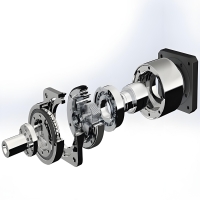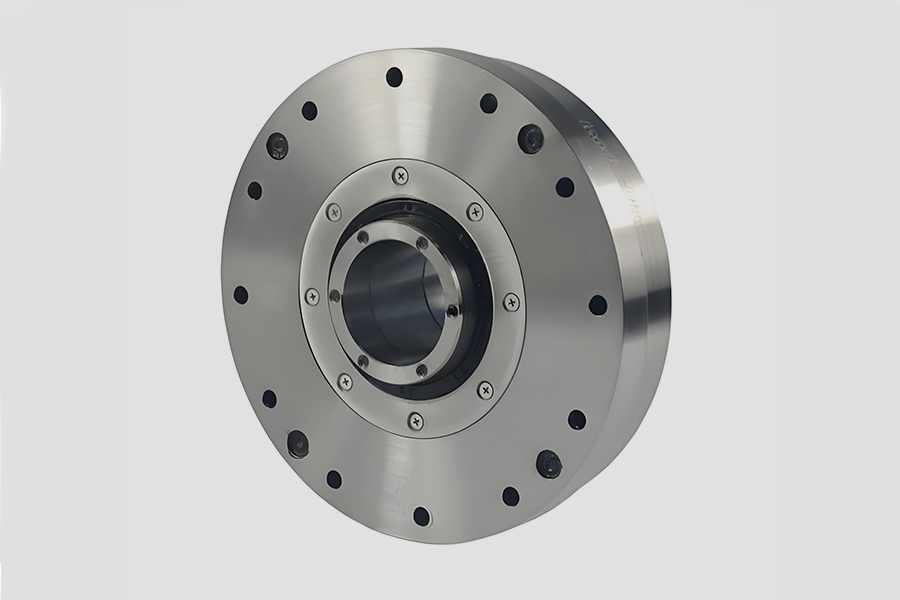


Most standard bearings are designed to keep their original round shape during operation. Flexible bearings break this rule. Built as a special thin-wall ball bearing, they are made to fit the elliptical cam inside a harmonic reducer’s wave generator. Unlike ordinary thin section bearings that only save space, flexible bearings must safely undergo controlled, repeated elastic deformation while rotating.

When the wave generator cam spins, it pushes the bearing into an elliptical shape. The deformed outer ring transfers this motion to the flexspline, enabling the high reduction ratio and low-backlash motion that harmonic drives are famous for. Once the elliptical force moves away, the bearing returns to its circular profile without permanent distortion. This cycle repeats continuously during normal operation, so material uniformity and precise raceway grinding are critical for long service life.
These bearings are typically made of high-grade chrome steel, with carefully controlled wall thickness to balance flexibility and structural strength. Ball profiles and cage designs are tuned to reduce friction and wear under cyclic deformation stress. Even small defects on the raceway can shorten lifespan, so manufacturers maintain tight tolerances for every finished unit. Open configurations are common, as most harmonic reducers use integrated sealing and lubrication systems inside the gear assembly.
Flexible bearings are not universal bearings. They are purpose-built for harmonic drive assemblies. You will find them widely used in collaborative robot joints, humanoid robot wrists and elbows, where compact size and repeatable positioning are required. Precision automation rotary actuators and medical robotic devices also rely on these bearings for smooth, backlash-free motion. Some compact inspection equipment and miniature positioning stages adopt harmonic reducers with flexible bearings to achieve high torque output in limited mounting space.
Selecting flexible bearings needs more attention than choosing regular rolling bearings. Engineers should focus on cyclic deformation stress, operating speed range, lubrication schedule and temperature conditions. Incorrect preload or poor lubrication can lead to early fatigue failure. Matching the correct bearing size with the wave generator cam profile is essential to get stable reducer performance.
As collaborative robots and compact precision actuators keep evolving, demand for reliable flexible bearings continues to grow. For any harmonic reducer design, the flexible bearing remains one of the most critical components that directly decides the whole unit’s positioning accuracy and working lifespan.


We are a bearing manufacturing enterprise that integrates research and development, design, production, and sales.
© Copyright Hebei Tianma Bearing Manufacturing Co., Ltd 2026 © All Rights Reserved. sitemap